Thursday, 15 August 2024

2024 Kingston Invitational, Day 4, Rounds 6 & 7, 15 August

The two overnight leaders Conor Murphy and Stanley Badacsonyi drew their seventh round game and have been caught in the lead on 5½/7 by slow-starting Vladyslav Larkin who scored his fifth successive victory in beating Maciej Czopor. Two players, Kenneth Hobson and Roland Bezuidenhout, are on 5/7. Two rounds remain.

ROUND SIX

A clash between the two overnight leaders, Stanley Badacsonyi and Conor Murphy, might have been expected in the morning but the 14-year-old player from East Finchley was otherwise engaged and took a half-point bye. His prior engagement was a family trip to learn (and hopefully celebrate) his elder brother's A-Level results, which is something which has become quite a thing in the UK. For those not familiar with the British educational system, A-Level (A stands for 'advanced') exams are taken around the age of 18 which largely determine which university the student goes to (or not, as the case may be).


The Browning Version of the Ruy Lopez led only to a draw against Murphy

Instead Murphy was paired with FM Alex Browning. The German-registered player, with White, played the slightly unusual 5 d4 line in the Ruy Lopez. Black equalised fairly easily against this. With a largely symmetrical pawn structure and level material, little else of note occurred and the result was a draw.


Zhuo Ren Lim was a pawn down against Maciej Czopor but his position was solid as a rock

The battle of the two FMs, Maciej Czopor against Zhuo Ren Lim, promised to be a livelier affair after opening with a Najdorf Sicilian side-line. Czopor (White) managed to exchange queens and gain a pawn but his position wasn't conducive to exploiting his material advantage and the game eventually fizzled out to a draw.


Vladyslav Larkin is fast gaining on the leaders, scoring a brilliant win in round 6

Board three was the scene of an exciting showdown between Michael Healey (White) and Ukrainian IM Vladyslav Larkin. The opening was 1 b4, or the "Polish Orangutan" as the software I use likes to style it. (Are there orangutans in Poland? I think we should be told.) There was nothing much wrong with the opening phrase of the game for White but when he dared to fork his opponent's knight and pawn, he was suddenly "terminated with extreme prejudice" (if I may borrow a euphemism from Apocalypse Now). The killer move, 14..d4, had to be calculated with great precision: Larkin proved equal to the task.


IM Gavin Wall gave a master class in how to win a level rooks and pawns endgame

Gavin Wall scored an instructive win against Zain Patel, similar in a way to the Larkin win for the suddenness with which the game turned, but this was a more positional version of the same.

ROUND SEVEN


Stanley Badacsonyi gave Conor Murphy a fright but the game ended in a draw.

After his dominating performance in the 2023 Kingston Invitational and other recent competitions, plus his near 300 point rating superiority, IM Conor Murphy might have been expected to overcome Stanley Badacsonyi in their top board encounter in the Thursday afternoon, but it was the 14-year-old who came closest to winning the game. A draw was probably enough to take Badacsonyi over the threshold of 2300 for his FM title (subject to confirmation).

The opening was a side-line of the McCutcheon variation of the French Defence. After the queens came off in a level position, Murphy, playing White, had a slight edge but mishandled it and allowed Badacsonyi to equalise. Murphy then overdid it in trying to win and for a fleeting few moves stumbled into a technically lost position. That said, it would have required a counter-intuitive, super-GM/Stockfish-level move (not to mention plenty of time on the clock) to seal the deal for Black, who shouldn't beat himself up too much for missing it.


The top boards in round 7 practise synchronised handshaking
which is going to be trialled as a sport at the 2028 Los Angeles Olympics. 

Vladyslav Larkin defeated Maciej Czopor after an innocuous opening became unexpectedly sharp. The Polish player, with Black, missed an opportunity to hold after which White's kingside assault broke through.


Who dares wins: Roland Bezuidenhout took a big risk against Bob Eames and it paid off.

The game between Roland Bezuidenhout (White) and Bob Eames seemed to be pootling along in fairly normal fashion when the South African suddenly launched a sacrificial attack. It was dangerous, though probably unsound, but Black failed to follow up accurately and duly lost.

There was more risk-taking on board five where Alex Browning (playing Black) was outplaying Kenneth Hobson. Then, on move 39, calamity: Browning, the exchange and a pawn up, took a pawn and allowed a mate in two.

I think I'll leave it there for now. It was an exhausting round to watch, let alone play, which might account for some of the mistakes made. Everyone is getting tired. One of the games from round 7 has not yet finished. They had reached move 203, in a position where one pair of queens, bishops and pawns had been exchanged, when the arbiters decided enough was enough and asked them to adjourn. The game is due to be resumed at 8.15am tomorrow, with round 8 scheduled for 10.00am. 

Round eight starts at 1000 BST on Friday 16 August, with round nine (the final round) at 1530 the same day. Follow the action live at Lichess.org and find the latest results at chess-results.com. Also look out for me on X/Twitter for regular comments - @johnchess - and also @KingstonChess.

2024 Kingston Invitational, Day 3, Rounds 4 & 5, 14 August

 Just beyond the halfway point of the tournament we now have two joint leaders on 4½/5: IM Conor Murphy and CM Stanley Badacsonyi. They haven't yet met, and won't do so in round six as the youngster from North London is taking a half-point bye in that round. In third place is Polish FM Maciej Czopor on 4/5 while a further seven players have 3½.

ROUND FOUR

After all those things I wrote in my last report about the absence of quick draws, etc, the round four top board game between Maciej Czopor and Conor Murphy ended in a draw in 15 moves. This coincided with the fact that I was late in arriving. Consequently I failed in my photographic duties and missed the chance to snap them... 


As King Charles I said, "I see the birds have flown."

TS Venkataramanan v Stanley Badacsonyi
TS Venkataramanan vs Stanley Badacsonyi: an entertaining scrap.
And on the next board, in-form Bob Eames overcame Mike Healey

That left the third of the three leaders, Stanley Badacsonyi to battle it out against T S Venkataramanan and he did so successfully to wrest the sole lead with 4/4. It was great fight, reflecting credit on both players.

Bob Eames won his third game in a row, beating Mike Healey. Black chose to decline a Morra Gambit but soon came to regret it as White created something resembling a Maroczy Bind, followed by a powerful queenside pawn storm.


All gambit pawns gratefully accepted: Jem Gurner beat Peter Lalic

The Malaysian FM Zhuo Ren Lim had a good win against Matthew Dignam after tempting his opponent into accepting an unusual counter-gambit against a c3 Sicilian. Alex Browning also won when his kingside attack crashed through against Supratit Banerjee. Elis Denele Dicen found herself ground down in a long rook and pawns endgame by Tom Villiers. Peter Lalic was another Morra Gambiteer, but his gift was accepted by Jem Gurner, who also gratefully annexed a second and then a third. Lalic reduced the deficit from three to one but at the cost of ruining his position.

Ewan Wilson was two pawns up with a good chance of winning but the capture of a third saw him facing (Kenneth) Hobson's choice...

Zain Patel
Zain Patel won a tricky endgame in round four

Zain Patel won against Edmond Andal after the Philippines player missed a saving move in a rook and pawns endgame.

ROUND FIVE


Stanley Badacsonyi put up a tough rearguard to preserve his lead, now shared with Conor Murphy

In round five the leader, Stanley Badacsonyi, found himself paired with the number three seed FM Maciej Czopor. White opened with something I've not seen before - 1 d4 Nf6 2 Nc3 d5 3 Bf4 e6 4 Nb5!? - but that might be because my chess knowledge, such as it is, is firmly rooted in the 20th century, before he was born. It didn't work out particularly well and White's slow development led to some problems along the e-file which he could only meet by surrendering the right to castle. However, Czopor's advantage was dissipated by an ill-judged queen exchange and he was unable to dominate the ensuing double rook ending in the way that he might have expected. Badacsonyi's recovery after mishandling the opening show he is a tough fighter.


Murphy-Eames was a long struggle which the Irish IM finally won

That left last year's winner IM Conor Murphy with the task of defeating Bob Eames with White to tie with Badacsonyi for the lead. Eames defended a Benkö Gambit. Murphy sacrificed the exchange for a pawn, making two in total with the addition of the traditional Benkö pawn. Stockfish was unimpressed, judging the position to be level but, as is so often the case, the practicalities of the position told a different story, with Black being faced with a series of difficult defensive problems while the white king remained safely out of harm's way. That said, Eames coped with most of them extremely well, before stumbling over the final question posed by the relentless Irish examiner.

The highlight of the afternoon for me was not one of the games but a pleasant chat with one of the player's coaches who was present at the venue. Here's his photo...


Zhang Pengxiang is in Kingston as coach to Jack Liu - but take a look at his chess CV below...

Zhang Pengxiang is a 44-year-old Chinese grandmaster, who is currently rated 2567 but with a peak rating of 2657. He is less active as a player these days, concentrating on his work as a chess coach, but his chess CV includes some awesome achievements. In 2001 he qualified for the FIDE World Championship in Moscow when the format was knock-out matches of two classical games followed by rapid and blitz tie-breakers. In the first round he drew the two classical games but won both the subsequent rapidplay games to eliminate his opponent... who was Anatoly Karpov. It's worth reading the description of this extraordinary achievement on his Wikipedia page

Zhang has played in Britain twice before. In 2007 he was part of the powerful Chinese team which overcame the British team in a match-tournament held in Liverpool. His results on that occasion were wins against Mickey Adams, Jonathan Rowson and Nick Pert, draws with Nigel Short and Gawain Jones, and a solitary loss to David Howell, for a rating performance in excess of 2700. More recently he was invited to play in the 2023/24 Hastings Masters by tournament director Stuart Conquest and finished 2nd to Abhijeet Gupta with an unbeaten 7/9.

Zhang has a charmingly modest demeanour and it was a real privilege to chat with him. And how great for young players like Jack Liu that they get the opportunity to learn from him. 

On that upbeat note I shall close this report for now - it's gone 1am in the morning and I'm an old gent who needs his sleep. But I might add a few more observations tomorrow.

Round six starts at 1000 BST on Thursday 15 August, with round seven at 1530 the same day. Follow the action live at Lichess.org and find the latest results at chess-results.com. Also look out for me on X/Twitter for regular comments - @johnchess - and also @KingstonChess.

Wednesday, 14 August 2024

2024 Kingston Invitational, Day 2, Rounds 2 & 3, 13 August

After another sultry day of chess here in TrafficJam-upon-Thames, the leaders are now Irish IM Conor Murphy, Polish FM Maciej Czopor and English CM Stanley Badacsonyi on 3/3.

First we must congratulate all the players in the tournament, not to mention the officials, on managing to get to the venue at all. As mentioned yesterday, there are huge traffic problems in Kingston-upon-Thames at the moment. Kingston Council reported that "Queen Elizabeth Road Kingston - Urgent Road Closure at the junction with Birkenhead Avenue due to the discovery of a large void in the carriageway. Estimated end date is currently 16 August 2024." Note that those dates coincide exactly with the start and end dates of the tournament, and the road closed happens to be the one immediately outside the venue. How unlucky can we get? The only tournament that comes close in misfortune in this respect is probably the recent British Championship in Hull which coincided with an outbreak of public disorder in Hull which led to the hotel venue having to lockdown at one point. However, thankfully, the large void in the adjoining road has not led to an equivalent void in the list of competitors.

ROUND TWO

One of the other most impressive features of the competitors is their fighting spirit. Round one featured 17 decisive results and just four draws. Perhaps not so surprising for a top vs bottom starter round but the trend has continued. In round two there were again four draws and 18 decisive games. In round three there were six draws and 16 decisive games. The draws have nearly all been full-blooded battles, too, with one going to an eye-watering 137 moves. The tournament organiser keeps nagging me to make a come-back and play the odd game as a filler, but he's got another think coming. Chess as played these days is too relentless for my cowardly blood and I shall remain a devoted spectator, thank you very much. I'm not the only one. We're told that the tournament's LiChess live audience is steadily growing.

Vladyslav Larkin
A tough start for IM Vladyslav Larkin but he won his round 3 game to reach 1½/3.


Good day at the office for Bob Eames: IM scalp in the morning and a smart win in the afternoon.

In the morning round the higher rated generally did better than in the first round but there were still some surprises. Top seed Ukrainian IM Vladyslav Larkin, who took a half-point bye in the opening round, lost to English FM Bob Eames. Larkin appeared to have escaped some early difficulties and secured an advantage but then blundered away material. 

Some of the youngsters who had excelled in round one ran out of luck in round two. George Zhao seemed to be matching Michael Healey blow for blow beyond move 40 and was a pawn up when a small slip enabled White to mount a decisive kingside attack. Similarly Zain Patel ran into tactical trouble against Tom Villiers whose back rank threats proved more potent than his opponent's.

Remy Rushbrooke
Remy Rushbrooke won an impressive game against IM Peter Large

There was a further surprise as Cambridge University player Remy Rushbrooke beat Peter Large. The veteran IM arrived 20 minutes late for the start - no doubt the traffic problem was to blame - and his opening play proved a little too provocative.

ROUND THREE


All-Irish clash on the top board: Conor Murphy defeated Gavin Wall

Board one in round three was an all-Irish clash between IMs Conor Murphy and Gavin Wall. Black opened with his trusty Philidor's defence but once 12...c5 was played it started to resemble a Sicilian with players attacking kings on opposite flanks. White's 14 Na4 looked odd at first sight but it proved to be a subtle plan to lure Black's light-squared bishop to go after it and win a pawn, enabling its opposite number to control the light squares on the opposite side unchallenged. The plan proved very effective and White's kingside assault soon crashed through. 


Macieja Czopor joined the overnight triumvirate of leaders with 3/3 after grinding down Tom Villiers.

Macieja Czopor joined Murphy and Badacsonyi in the joint lead after beating Tom Villiers in a 92-move marathon. After 52 moves it came down to an endgame of knight and two unconnected pawns versus bishop and one pawn, which the tablebase tells us is a draw. A further 40 moves ensued until the black king managed to circumnavigate the white forces and reach a position where White had only one move which maintained the draw. It wasn't a particularly hard one to find, involving the 'shouldering off' of the black to prevent it reaching the passed black pawn via the back gate (if you see what I mean), but, probably in a state of exhaustion, White missed it and was soon lost.


Stanley Badacsonyi reached 3/3 after beating Alex Browning

Stanley Badacsonyi is the third member of the round three leadership group, after beating German-registered Alex Browning. This talented 15-year-old from East Finchley, who won the British Junior Under-16 Rapidplay and Blitz titles in Hull, has started in great shape in Kingston. In round three he opened with the Trompowski against the German FM and was quickly on the offensive after Browning went in for an inferior line which ceded the dark squares and also a pawn to his opponent. It was all over in 28 moves.

I mentioned earlier that Bob Eames had a nice win in the afternoon, neatly bookending his IM scalp of the morning. Let's end by having a look at it.

Round four starts at 1000 BST on Wednesday 14 August, with round five at 1530 the same day. Follow the action live at Lichess.org and find the latest results at chess-results.com. Also look out for me on X/Twitter for regular comments - @johnchess - and also @KingstonChess.

Tuesday, 13 August 2024

2024 Kingston Invitational, Round 1, 12 August

 The 3rd Kingston Invitational got underway on a baking hot day at Tiffin Boys' School this afternoon. As well as the extreme heat, those travelling to the venue for the 3.30pm start had to cope with a gridlocked town centre which added an hour or even more to some journeys of those arriving by road, and it seems the rail services weren't great either. (I'm assuming no one arrived by river though that is a feasible option in this suburb of south west London through which the River Thames flows.) It's fair to say that organiser Stephen Moss feared the worst as the clock ticked round to the half hour. But his worries proved unfounded. His opening address, followed by chief arbiter Lance Leslie-Smith's technical briefing, meant that clocks were started only a little later than scheduled at 3.40pm and within another five minutes all 21 boards featured two players. An added bonus was air-conditioning in the playing room, which is not something to be taken for granted in the UK.

Barden Cup
The Barden Cup will be presented to the under-16 player with the best score.
Named after (who else?) Guardian chess columnist Leonard Barden, with his permission.

Incidentally, if you're wondering why this daily report is appearing on my personal chess blog and not on Kingston Chess Club's excellent website, it's a purely technical thing. The organiser's computer malfunctioned a few days before the tournament and he hasn't had a chance to remedy it. Rest assured, normal service will be resumed as soon as possible. 

This year's Kingston Invitational is being run for the first time as a Swiss, which meant the usual first round pairing of top vs bottom. If you wander over to the chess-results.com page expecting to see a monotonous series of 0-1, 1-0, 0-1, 1-0, 0-1 digits in the results (or vice versa), you're in for a surprise as there were quite a number of giant-killing performances this afternoon, as those sporting 2200+ ratings struggled to beat their supposed inferiors weighing in around Elo 2000.


Top board saw Conor Murphy overcome Alistair Hill

That said, the 2023 Kingston Invitational winner, IM Conor Murphy, was not one of them. His opponent, Battersea Chess Club's Alistair Hill, soon found himself in trouble when his knight was trapped behind enemy lines and unable to help defend against the Irish IM's kingside attack which soon crashed through. View the game on LiChess.

Board four was the scene of a surprise as Oxford University player Jem Gurner defeated IM Graeme Buckley. The titled player is known as a risk-taker but he pushed his luck a bit too far when he surrendered a piece for a kingside attack which had insufficient venom. But the game featured one inexplicable moment: when White played 33 Bxc5, why didn't Black reply 33...Bxc5 34 Qxc5 Qg3+ and Black must win. A scoring error somewhere?


14-year-old Elis Denele Dicen defeated FM Roland Bezuidenhout on board 5

The next board saw an extraordinary number of swings of fortune as the sole female competitor, WCM Elis Denele Dicen won against FM Roland Bezuidenhout. The South African player went in for a very timid Réti set-up with White and it took him until beyond move 40 to emerge from a grovelly position against his tenacious 14-year-old opponent. Eventually a chance came to attack for White to attack on the kingside but White hesitated and Black found a powerful move threatening the exposed white king. I've no doubt the brisk time limit now played a significant part as fleeting chances came and went for both sides. Two or three times White missed chances to play a g4-g5 pawn push to attack the black king but, irony of ironies, when he finally played it, it turned out to be a blunder losing material. A tremendous performance from the 14-year-old player of the black pieces whose fighting spirit and determination finally paid off.

Zain Patel
"Sorry I'm a bit late!" Zain Patel seems to be saying to Daniel Gallagher.

Zain Patel was the last competitor to arrive, having spent more than an hour stuck in the Kingston traffic with his mother, but he looked none the worse for the ordeal as he shook hands with his opponent and got the game underway. On move 12 Black snaffled his opponent's a-pawn with a knight - "pawn snatching at the expense of development," the old-time chess primers would have called it, but it seemed to work out rather well, though it was touch and go in the opening. Let's look at the game, which was very entertaining.

Tom Villiers seemed doomed to be the victim of yet another giant-killing when he lost the exchange in the middlegame against Balahari Bharat Kumar leaving him with a hopeless position. But a misstep by the 15-year-old allowed Villiers to give up his queen for rook and knight simply to stay in the game. Villiers also had two extra pawns which made a draw the likeliest result. On move 56 Black's last pawn was exchanged off leaving Black's lone queen to defend against rook, knight and three pawns (though two were doubled). In theory the draw was still attainable - it remained the analysis engine verdict for some time after - but in practice the defence of such positions where the opposing king can be shielded from a long series of checks is next to impossible. White could now continue playing with no fear of defeat and Black eventually cracked. At 82 moves this was the longest game of the round.


George Zhao, British Under-12 Champion, scored an excellent victory over Peter Lalic.

Another big surprise unfolded on board 12 where CM Peter Lalic succumbed to the newly-crowned British Under-12 Champion, George Zhao. Lalic met the 11-year-old's Queen's Gambit with 2...e5 and the game followed theory until move 11 where Zhao opted to capture a stray a-pawn, much as we saw Patel do above, though, with the queens already off, the pawn was less 'hot'. Initially Black had sufficient compensation for the pawn but a careless 14...Be7 allowed a neat combination which turned the extra pawn into a solid plus for White. Not long after, White netted a second pawn and set up an unstoppable phalanx of three connected pawns on the queenside. Thereafter Black's attempts at counterplay were easily quelled. This is the first time I've seen a game of George Zhao's and I am mightily impressed by what I've seen. Here is a link to the game: look out for a very classy series of moves by his light-squared bishop, particularly the precise 18 Bf5! in a position where I'd bet most 11-year-olds, indeed all ages up to and including 71-year-olds like yours truly, would simply snap off the c7-pawn. 


Robin Haldane (White) defeated Clive Frostick. Beyond Haldane is Stanley Badacsonyi, who beat Billy Fellowes, and beyond Badacsonyi you can just make out George Zhao who beat Peter Lalic.

Two players of pensionable age met on board 14 where the more senior but lower rated Robin Haldane defeated Clive Frostick. I wouldn't classify this as a surprise, however, since Haldane seems to have been underrated for the best part of half a century. The game was decided by a senior moment on move 20 committed by the junior partner, leading to an exchange of major pieces and the loss of a pawn and allowing White to show off his impeccable endgame technique. (Note: Robin Haldane is only playing as a filler so is not in the second round pairings but might return later in the event should he be needed.)

Mark Josse was another victim of a lower-rated opponent, namely Ewan Wilson. An injudicious exchange of pieces by White allowed Black to exploit the weakness of the white queenside pawns in an endgame. Black allowed White one fleeting chance to achieve a perpetual check on move 33 but White missed it and was soon lost. Link to the game.


Will Taylor of Kingston CC scored a 'home' win against Tim Seymour

The seventh and final success for the lower-rated opponents in round one was achieved by Kingston CC's very own Will Taylor against Tim Seymour of Surbiton. As an old-time King's Indian Defence addict myself I would have been glad to see White's slow-motion development unfold before me, rather than the usual high-speed pawn storm that used to pen me into my back two ranks and cause me much suffering. As a rule of thumb you should never allow a KID-ologist an even break or suffer the consequences. Black, playing with the freedom of a man who had expected a long term of KID imprisonment but had unexpectedly beaten the rap, engineered a temporary exchange sacrifice which guaranteed him complete control of the dark squares on the kingside, and that was enough to ensure victory.

That's it for now. Round two starts at 1000 BST on Tuesday 13 August, with round three at 1530 the same day. Follow the action live at Lichess.org and find the latest results at chess-results.com. Also look out for me on X/Twitter for regular comments - @johnchess - and also @KingstonChess.

Monday, 4 December 2023

Using ChessBase: A Technophobe's Guide to Sending Chess Game Scores by Email

This is a personal guide to emailing chess games when using ChessBase*. Like everything else, it's easy when you know how, but I've come across experienced players, long established in the chess world, even professional players, who are a little unsure about how best to go about it.

I'll give you an example of someone who is a little unsure about it: me. OK, I'm joking but there is a point to this. It occurs to me that ChessBase probably has a built-in 'email game' function but I don't know, despite being an assiduous and regular user of their software for nigh on 30 years. Does it? I just checked and it does, right there on the File drop-down menu - 'Email Selected Database'. But there is no way in the world that I am ever going to use it as I don't need to. I choose to use the email client of my choice, giving me control over the drafting of the message and the attachment of files. This is a purely personal guide to how I carry out this function.

(* note: I use ChessBase 14 - I can't guarantee that all of the functions and options I refer to in what follows will be present in earlier or later versions of ChessBase)


FIRST STEP: SETTING THE 'OLD PGN' OPTION IN CHESSBASE

In my first draft of this post, I completely forgot to include this first step. It's easy enough to do but a bit harder to explain why it's necessary. So I won't bother - just trust me, OK?

In ChessBase, press CTRL+ALT+O to invoke the options menu - that's three keys pressed simultaneously, and it's the letter 'o' not zero. 

A small window headed 'Options' will appear in the centre of your screen. Click where you see Clipboard on the left, and you should now see a screen that looks something like the following...

The Options window: set PGN to Old Format

There are various clickable options towards the right of the screen, but the only one we care about right now is the one I've crudely surrounded by a red circle. Set that to OLD FORMAT and then click OK. That's the set-up done. (I personally leave this option set permanently to OLD FORMAT and have suffered no ill effects from it.)

SENDING A SINGLE GAME

Let's say you want to send someone a single game. This is fairly simple and doesn't require a deep knowledge of ChessBase functionality. I'm assuming the reader has some basic knowledge of how ChessBase works.

  1. load the game in a ChessBase window;
  2. copy it (CTRL + C on Windows, COMMAND+C on a Mac);
  3. switch to your email client and start a new message;
  4. paste the game (CTRL+V or COMMAND+V) into the message window.

In the email message window the game will look something like the text between the lines below...


[Event "Hastings Premier 1932/33 13th"]
[Site "White Rock Pavilion"]
[Date "1932.12.31"]
[Round "4"]
[White "Sultan Khan, Mir"]
[Black "Menchik, Vera"]
[Result "1-0"]
[ECO "D35"]
[PlyCount "79"]
[EventDate "1932.12.28"]
[EventType "tourn"]
[EventRounds "9"]
[EventCountry "ENG"]
[SourceTitle "BritBase"]
[Source "John Saunders"]
[SourceDate "2023.12.02"]
[SourceVersion "1"]
[SourceVersionDate "2023.12.02"]
[SourceQuality "1"]

1. d4 Nf6 2. c4 e6 3. Nf3 d5 4. Nc3 Nbd7 5. cxd5 exd5 6. g3 Bd6 7. Bg2 c6 8.O-O O-O 9. Nh4 Re8 10. Nf5 Bf8 11. Qc2 Nb6 12. Nh4 Be6 13. Rd1 Qd7 14. a4 Rad8 15. a5 Nc8 16. Na4 Bh3 17. Bg5 Bxg2 18. Nxg2 Qg4 19. Bxf6 Rxe2 20. Qxe2 Qxe2 21. Bxd8 f6 22. Bc7 g5 23. Ne3 h5 24. a6 bxa6 25. Rdc1 Qb5 26. Nc3 Qxb2 27. Rab1 Qd2 28. Rc2 Qd3 29. Rb8 Ne7 30. Bd6 Kf7 31. Ncd1 a5 32. Rcb2 a4 33. R2b7 a3 34. Rxa7 a2 35. Rxa2 f5 36. Raa8 Bg7 37. Rb7 Bf6 38. Bxe7 Bxe7 39. Raa7 f4 40. Rxe7+ {Sources: The Times, 3 January 1933; Birmingham Daily Post, 5 January 1933} 1-0


... but don't be put off by the looks of it or be tempted to edit it to look friendlier to the human eye. It's a PGN representation of a chess game score, where PGN stands for Portable Game Notation - and the recipient of your email (assuming they are reasonably ChessBase-savvy and are interested in the game) will be more than happy to see it set out like this. They'll copy your game score straight from your email with one deft stroke of their mouse, paste it into a new ChessBase game window and save it into their own database without having to retype a single character.

5) Any explanatory text and comments you can add to the email before or after the PGN game score segment.

6) Type in the recipient's email address, click send and you're done. And you've hardly needed to know anything about ChessBase except how to load a game and copy it.


SENDING MULTIPLE GAMES

Now let's find the best way to send more than one game: two games, half a dozen, 20, 30...

You could simply follow the above directions, cut and paste multiple games into an email window as before. That's a reasonable solution where you're only dealing with 2-6 games but it's a bit cumbersome when you're starting to deal with a larger number of games. This is where you'll need to learn a few ChessBase tricks.

In ChessBase we're not going to start from a game window this time but from a game list, which includes the games that we wish to transmit.

Starting from the database window which we can think of as ChessBase's home page, double-click on the database that has the game scores that you want to send by email.

1) mouse-click left on the 'Games' tab to show you a list of games in the database
2) highlight a game by mouse-clicking left on a game in the list;
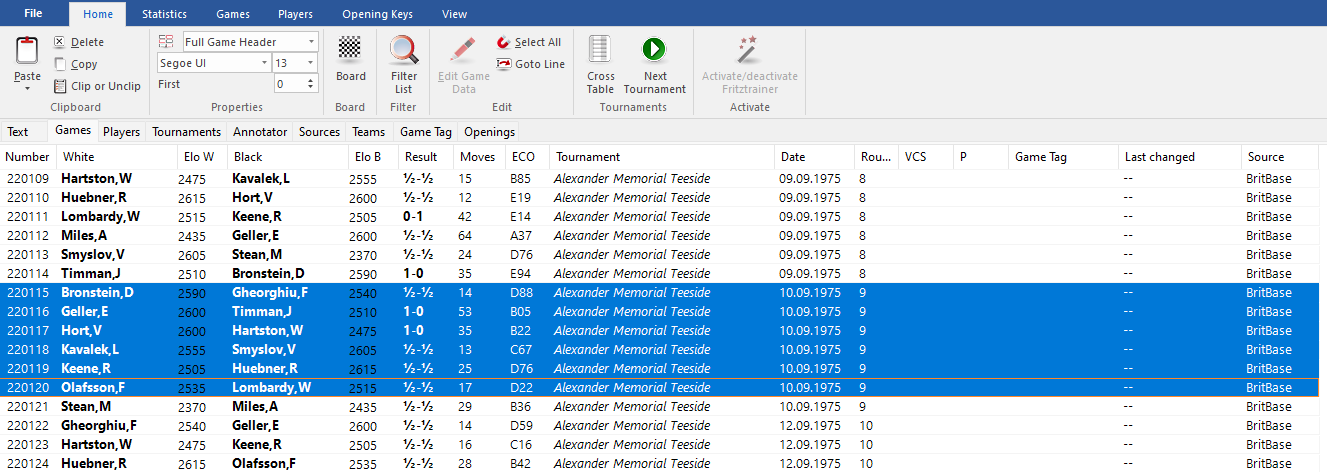
3) whilst holding down the shift key, mouse-click left on another game below (or above) the game already highlighted, so that you've got about half a dozen games highlighted;

Highlight the games to include in the PGN file

What you see on the screen should look something like the above, showing a number of games highlighted. These are the games which we are about to turn into a PGN file which can be sent to an email recipient.

4) position the mouse pointer somewhere in the highlighted area and mouse-click right; you should now see a drop-down menu. Now move the mouse pointer over the OUTPUT option, which reveals a further drop-down where you're going to choose the SELECTION TO TEXT FILE option...

Here's what you should be looking at on the screen...

Highlight the games to be sent, hover over OUTPUT, click SELECTION TO TEXT FILE

... with the red circles I've crudely drawn showing where OUTPUT and SELECTION TO TEXT FILE options appear on the screen.

5) You now want to mouse-click left on SELECTION TO TEXT FILE (but PLEASE DON'T CLICK on the Email Selected games option immediately above it! That might sound like the thing that you want to be doing but, trust me, it isn't)

This opens up a new small window on the screen...

Click on PGN in the left-hand column (not the middle column)


6) ignore the two columns to the right for now and in the left-hand column, 6th item down, click PGN

This opens up another window, which looks like this...


Click on PGN (left-hand column) and put a tick in the OLD FORMAT box


7) mouse-click left where it says OLD FORMAT to put a tick in the box and click OK. (I could explain why we make this choice but it's better not to know and just trust me.)

8) This opens up a new window which is inviting you to create a PGN file containing the games that you have previously highlighted. First making sure that the SAVE AS TYPE field shows PGN Format (*.pgn), it's now up to you to choose a meaningful name for the file you are creating and a suitable folder to locate it.

That concludes the ChessBase part of the process. You can now prepare your email message, attach the PGN file which you have just created (just the one file suffixed *.PGN - ChessBase may create other small files with the same name but different suffixes but you don't need to send them) and send the email. Job Done.


THERE IS ANOTHER WAY TO DO THIS BUT BEWARE...

... it may seem simpler at first but it can work out more problematic in the long run. I'll describe it in outline: you create a PGN database in ChessBase, copy games into it, then attach it to an email, and then send it. Sounds simpler and more logical but there are snags. Over the years I've come to dislike creating PGN files in that way. For one thing ChessBase is very 'clingy' when it comes to such databases. For example, it might not let you upload PGN files created in this way to the web without first closing the ChessBase software. (That's the sort of thing that could take you hours to figure out.) And the resultant PGN file may also include some strange-looking gobbledegook generated by later versions of ChessBase that may confuse recipients of your email. (That all-important tick in the OLD FORMAT box at step 7 above eliminates this strange stuff. Similarly, I can now reveal that the reason we took that first step, right at the beginning of the post, to set PGN to OLD FORMAT in the Options menu, was to eliminate this meaningless gunk from appearing in PGN notation when copied from a game window)


CHOOSING WHICH GAMES TO SEND

This is slightly off-topic and more about understanding ChessBase functionality but I thought I would share a couple of thoughts about how to get games ready for transmission.

The example I gave above was simplistic - a sequence of half a dozen games in precise order on a games list. The games you want to send out may be from different areas of your ChessBase set-up, e.g. from a player index, a tournament Index or from separate databases.

In those circumstances, the Clip Database function in ChessBase is your friend. It's worth getting to know how it works, how to put games in it, how to sort them into a given order, how to clear it, etc.

ChessBase's Clip Database is your friend

The Database Window (Home Screen - 'My Databases') should have a database icon labelled CLIP DATABASE. One important use for it is to gather together some games which you want to send  to someone.

Double-click on CLIP DATABASE. If you've never used it before, it will be empty. Just headers, no games. If it has games in it, and assuming that you've now finished whatever it was you were doing with them, you can get rid of them. To do this, go back to the database window, mouse-click right on the icon and choose ERASE CLIPBOARD (or CTRL-ALT-V) on the keyboard. Don't let the word ERASE frighten you - none of the games on your databases will be harmed in the process. This does NOT delete games from the database in which they reside, it simply removes them from the Clip Database, which you can think of as a place where you temporarily make copies of games and group them for further action.

Now you have an empty clip database, you can (re)populate it with the selection of games you wish to put in your PGN file to send out. You do this by going to any database, highlighting a game or games from a list and clicking function key F5 (there's another mouse-driven alternative to using the function key but it's a bit clunky so let's not worry about it - just try to remember that F5 adds games to the Clip Database, or, if they are already on it, removes them). 

Once you've finished selecting the games you want to put in your PGN file, you return to the database window, double-click on the Clip Database icon and you should see all the games that you've added. If you've accidentally added a couple that you don't intend to send, highlight them and press the F5 function key again and they'll disappear from the Clip Database (again, they will not disappear from their home database, just from the Clip Database). 

You can change the order in which the clipped games appear on the screen by clicking a header. (Typically, you'll want to put them in chronological order so you'll probably click the 'date' header.) Once you've got the list of games you want to send in the order that you like, you highlight all the games. CTRL+A highlights all the games in the Clip Database window. Now you can proceed to point 4 above to create the output PGN file. The rest of the steps are the same as given there. 


SENDING BIG DATABASES

A much less likely scenario arises when you want to send a really big database, let's say, one containing upwards of 20,000 games. For this the PGN file option is not ideal. In fact, it may not work. A lot of email servers prevent users from sending large attachments. A PGN file of 20,000 games could weigh in at 10+ megabytes. In those circumstances ChessBase's own solution becomes almost essential, namely a ChessBase archive file (suffixed *.cbv in the Windows Explorer list).

Creating a ChessBase archive file is quite easy. Highlight a database in the database window by mouse-clicking left, then mouse-click right, hover with the mouse over the TOOLS option and select BACKUP DATABASE. (the keyboard equivalent is easier - CTRL + Z). A small window appears, offering encrypted or non-encrypted format, set unencrypted (it's the default setting) and click OK. It now invites you to choose a name for the backup/archive file. Make sure you choose a meaningful name and remember which folder you chose to save it in. The backup file (look for the file you named suffixed *.cbv in Windows Explorer - ignore all the other files suffixed otherwise) contains the entire database in a more compact format and can be sent as an email attachment with a better chance of staying within limits for email transmission.
Back-up to a ChessBase archive (*.cbv) file - CTRL+Z or right-click TOOLS / BACKUP DATABASE


WHY DON'T I RECOMMEND CHESSBASE ARCHIVE (*.CBV) FILES FOR SENDING ANY DATABASES? 

Now I've told you about the advantages of creating ChessBase archives - ease of creation, saving space - you might be tempted to use them for sending database files of small and medium sizes, not just whoppers. You create a new ChessBase database, put all the games you need to send in it, archive it and attach the archive to an email and that's it.

Yes, you can do that. But I wouldn't recommend it.

The problem is compatibility, or, rather, incompatibility. For a start, not everyone uses ChessBase and, if they don't, a ChessBase archive (*.cbv) will be unreadable on their computer, whereas the PGN format is universal - all chess software is (or should be) capable of importing it. 

The incompatibility situation has worsened in the past year or so. Even if  your intended recipient has ChessBase, their version of the software and yours may be incompatible. This didn't use to be a problem but ChessBase have seen fit to bring out a new version, ChessBase 17, which uses a database system which is incompatible with all previous versions in this respect. So if you're using ChessBase 17 and you create a database archive using the latest database format and send it to a friend who is still using an earlier version, they won't be able to do anything with it.

I personally use ChessBase 14. It is stable and does everything I need it to do and am not planning to upgrade to ChessBase 17. People occasionally send me CBV files (as I call ChessBase archive files) produced in ChessBase 17 and there's nothing I can do with them. I could ask them to send me material in the older database format, which CB 17 still supports - allegedly - but they could then get confused. (If you don't believe me, take a look at the 300+ pages of the ChessBase 17 user manual -  it does have solutions to compatibility problems but they are not easily discoverable. Seriously, if you are a ChessBase 17 user and wondering how to create a file of games which will be compatible with other people's chess databases, go to the linked page, click where it says 'Reference' on the left-hand menu, then 'Database Formats', then 'Database Formats' - or simply click on this link to go straight to the relevant page - and you can see how you can create a PGN format database in ChessBase 17.

So let's just stick to PGN for transmitting games. I hope this has been of some use to those who are unfamiliar with ChessBase - and if you know better ways to do some of these things, don't hesitate to get in contact with me at BritBase.info. That said, I probably won't take a blind bit of notice and carry on doing what I always do anyway. I'm an experienced user but a technophobe at heart.

Finally, a belated acknowledgement to Nick Murphy who, many years ago, achieved the impossible in weaning this grumpy old technophobe off ChessBase 7 and onto later versions of the software.